Nigeria eliminated wild poliovirus — so why are children still being vaccinated against polio?
It is a question many Nigerian parents may understandably ask.
Nigeria and the rest of the WHO African Region were certified free of wild poliovirus in August 2020. That achievement was historic.
However, it did not mean that every form of poliovirus disappeared from Nigeria.
In 2026, circulating variant poliovirus continues to pose a public health threat, especially in communities where many children have missed vaccinations. WHO says Nigeria continues to experience transmission of circulating variant poliovirus types 2 and 3.
That makes vaccination just as important today.
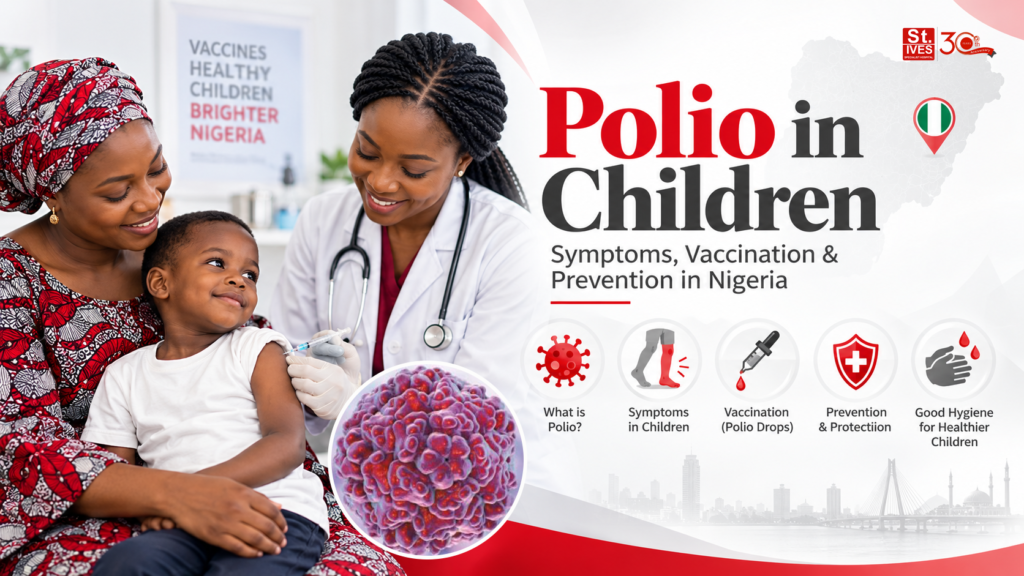
For parents, understanding polio in children, its symptoms, how it spreads and how vaccination protects children can help prevent a disease that may cause lifelong paralysis.
The encouraging news is simple:
Polio has no cure, but vaccination can prevent it.
What Is Polio?
Polio, also called poliomyelitis, is a highly infectious disease caused by the poliovirus.
It mainly affects children under five years old, although an unvaccinated person of any age can become infected.
The virus enters the body through the mouth and multiplies in the intestines.
In some cases, it reaches the nervous system and damages the nerves that control muscles.
This can lead to weakness or paralysis.
According to WHO, about one in 200 poliovirus infections can result in irreversible paralysis. Among people who become paralysed, 5–10% may die if the muscles needed for breathing stop working.
Fortunately, vaccination offers powerful protection.
Is Polio Still Present in Nigeria?
Yes — but an important distinction is necessary.
Nigeria no longer has endemic wild poliovirus.
The country achieved wild-polio-free status as part of the WHO African Region certification in August 2020.
However, circulating variant poliovirus, also known as cVPV or cVDPV, remains a concern.
WHO reported in 2026 that Nigeria continues to experience outbreaks involving circulating variant poliovirus types 2 and 3.
So when health authorities continue vaccinating children against polio, it does not mean Nigeria lost its wild-polio-free certification.
Instead, vaccination helps stop the remaining forms of poliovirus from spreading.
Why Does Variant Poliovirus Occur?
This part often causes confusion.
The oral polio vaccine contains a weakened form of poliovirus. After vaccination, the weakened virus can briefly multiply in the intestines and help build immunity.
In communities where most children have received enough vaccine doses, this helps protect the wider population.
However, if too many children remain unvaccinated or under-vaccinated, the weakened virus can circulate from person to person for a long period.
During prolonged circulation, it can change genetically and, in rare situations, regain the ability to cause paralysis.
This is called circulating vaccine-derived poliovirus.
The solution is not to stop vaccination.
The solution is to increase vaccination coverage so the virus has fewer unprotected children in whom it can continue circulating.
How Does Polio Spread?
Poliovirus spreads very easily from person to person.
The main route is the faecal-oral route.
This means tiny particles of stool from an infected person can enter another person’s mouth.
Transmission may occur through:
- Contaminated hands
- Unsafe water
- Contaminated food
- Poor sanitation
- Improper handwashing
- Contact with an infected person’s stool
The virus multiplies in the throat and intestines after entering the body.
Poor sanitation can therefore make transmission easier, especially in communities where vaccination coverage is low.
Young children may also spread the virus without anyone realising it because many infected people develop no obvious symptoms.
What Are the First Signs of Polio in Children?
One reason polio can spread silently is that many infected children do not appear sick.
Some children develop only mild symptoms that may look like another common childhood illness.
Early polio symptoms can include:
- Fever
- Tiredness
- Headache
- Vomiting
- Neck stiffness
- Muscle aches
- Pain in the arms or legs
WHO notes that most people infected with poliovirus experience no symptoms or only mild illness.
However, parents should pay close attention to sudden muscle weakness.
The Most Serious Warning Sign: Sudden Weakness or Paralysis
A child who suddenly struggles to move an arm or leg needs urgent medical attention.
Doctors call sudden weakness or paralysis acute flaccid paralysis, or AFP.
For example, a child may suddenly:
- Drag one leg
- Stop walking normally
- Struggle to stand
- Develop unusual weakness in an arm
- Lose movement in a limb
AFP does not automatically mean the child has polio.
Several medical conditions can cause sudden weakness.
However, health workers must investigate every suspected case quickly because rapid reporting helps Nigeria detect poliovirus and prevent further spread.
WHO highlighted this issue in September 2026 after a four-year-old girl in Kano State suddenly lost movement in one leg. Health workers investigated the case and eventually ruled out polio, but the case showed why parents should report sudden weakness immediately.
If your child suddenly develops weakness or paralysis in an arm or leg, take the child to a health facility immediately.
What Complications Can Polio Cause?
Most poliovirus infections do not progress to paralysis.
However, when the virus reaches the nervous system, the effects can become severe.
Possible complications include:
- Permanent weakness
- Paralysis of one or more limbs
- Muscle wasting
- Joint stiffness
- Limb deformity
- Difficulty walking
- Breathing problems
- Long-term disability
In severe cases, polio can affect the muscles responsible for breathing.
This can become life-threatening.
Some survivors may also develop health problems many years after their original infection.
Because doctors cannot cure polio once infection causes paralysis, prevention remains essential.
Can Polio Be Treated?
There is no cure for polio.
Doctors can provide supportive treatment to manage symptoms and complications.
Depending on the child’s condition, care may include:
- Pain management
- Physiotherapy
- Rehabilitation
- Breathing support
- Mobility support
- Treatment of complications
However, treatment cannot reverse every case of nerve damage caused by poliovirus.
That is why vaccination plays such an important role.
How Does the Polio Vaccine Protect Children?
The polio vaccine trains the immune system to recognise and fight poliovirus.
Nigeria uses both oral polio vaccine (OPV) and inactivated polio vaccine (IPV) as part of its immunisation programme.
Both help protect children, although they work in slightly different ways.
What Is the Oral Polio Vaccine?
OPV comes as drops placed in the child’s mouth.
It is especially useful in stopping community transmission because it builds immunity in the intestines, where poliovirus multiplies.
During vaccination campaigns, parents may see health workers giving children two drops of oral polio vaccine.
Children may receive OPV several times.
Repeated doses are safe and help build strong protection.
What Is IPV?
IPV stands for inactivated poliovirus vaccine.
A healthcare professional gives it as an injection.
Unlike OPV, IPV contains inactivated virus, so it cannot reproduce.
It produces strong protection against paralytic disease.
Nigeria’s vaccination programme uses both approaches to strengthen children’s protection.
When Should Children Receive Polio Vaccines in Nigeria?
Nigeria’s current routine childhood immunisation schedule starts polio vaccination from birth.
The NPHCDA immunisation guidance lists the following schedule:
| Age | Polio Vaccine |
|---|---|
| Birth | OPV 0 |
| 6 weeks | OPV 1 + IPV 1 |
| 10 weeks | OPV 2 |
| 14 weeks | OPV 3 + IPV 2 |
The national schedule may also include extra polio doses during supplementary vaccination campaigns.
Parents should therefore allow eligible children to receive campaign doses even if the child has already received routine vaccines.
Why Does My Child Need Polio Drops More Than Once?
Parents sometimes wonder why health workers keep offering polio drops.
Multiple doses help build stronger immunity.
In addition, mass vaccination campaigns help protect entire communities and stop the virus from circulating.
Receiving recommended extra doses during a polio campaign does not mean previous doses failed.
Instead, the campaigns strengthen protection across the population, especially when some children may have missed routine vaccines.
What If My Child Misses a Polio Vaccine?
Do not panic, and do not assume it is too late.
Contact your healthcare provider or visit an immunisation clinic as soon as possible.
A healthcare professional can review your child’s immunisation record and advise you about catch-up vaccination.
In most situations, children do not need to restart an entire vaccine series simply because a scheduled dose was delayed.
The important step is to return for appropriate catch-up vaccination.
UNICEF Nigeria advises parents whose children miss a vaccine to contact a healthcare provider or health clinic promptly so they can receive guidance on completing missed doses.
If you cannot remember which vaccines your child has received, take the child’s immunisation card to your paediatrician or vaccination clinic.
Can a Vaccinated Child Still Get Polio?
Polio vaccines provide very strong protection.
However, vaccination works best when a child receives all recommended doses.
A child who receives only part of the vaccination series may not develop the same level of protection as one who completes the recommended schedule.
This is why parents should keep immunisation appointments and participate in authorised vaccination campaigns.
Strong community vaccination also matters.
When many children have good immunity, poliovirus has far fewer opportunities to spread.
Are Polio Vaccines Safe?
Yes.
WHO, UNICEF, NPHCDA and other major public health authorities recommend polio vaccination because the vaccines have a strong safety record and protect children from a potentially disabling disease.
Like other vaccines, some injectable vaccines may cause mild temporary effects such as:
- Pain at the injection site
- Mild swelling
- Redness
- Low-grade fever
- Irritability
Serious vaccine reactions are very rare.
If your child develops an unusual or severe reaction after any vaccination, contact a healthcare professional.
Can a Child With a Mild Cold Receive a Vaccine?
In many cases, yes.
A mild cold or low-grade fever does not automatically mean vaccination must be postponed.
UNICEF Nigeria states that minor illnesses usually do not prevent vaccination.
However, if your child appears moderately or severely ill, speak with a healthcare professional before vaccination.
The doctor or immunisation provider can assess the child and advise you.
Why Vaccination Still Matters After Nigeria Eliminated Wild Polio
Nigeria’s wild-polio-free status is a major public health success.
Yet stopping vaccination now would create new immunity gaps.
When enough children miss vaccines, poliovirus can find susceptible people and continue spreading.
WHO‘s August 2026 review expressed concern that routine and supplementary vaccination activities have not reached every child in some high-risk parts of Nigeria.
Recent national figures also show that much of the remaining poliovirus burden is concentrated in areas with low population immunity.
Therefore, maintaining high vaccine coverage remains critical.
Wild poliovirus may be gone from Nigeria, but the job of protecting every child is not finished.
How Can Parents Prevent Polio in Children?
Vaccination provides the most important protection.
However, families can also support wider prevention efforts.
1. Complete Your Child’s Vaccinations
Follow the recommended childhood immunisation schedule.
Do not intentionally skip doses because your child appears healthy.
Vaccines work best before exposure to disease.
2. Keep Your Child’s Immunisation Card
Bring the card to vaccination and paediatric appointments.
It helps healthcare professionals identify missed doses quickly.
3. Participate in Polio Vaccination Campaigns
If an authorised vaccination team visits your community and your child qualifies, allow the child to receive the recommended polio vaccine.
Campaign doses help interrupt virus transmission.
4. Practise Good Hand Hygiene
Wash hands properly with soap and clean water:
- After using the toilet
- After changing nappies
- Before preparing food
- Before feeding children
- Before eating
Because poliovirus mainly spreads through the faecal-oral route, hygiene matters.
5. Improve Food and Water Safety
Use safe drinking water where possible.
Wash food properly and protect prepared meals from contamination.
Good sanitation supports polio prevention alongside vaccination.
What Should Parents Do About Vaccine Misinformation?
Parents naturally want to know that what they give their children is safe.
Questions are reasonable.
However, misinformation can become dangerous when it causes children to miss important vaccinations.
Nigeria continues to face vaccine hesitancy in some communities.
Current polio-eradication efforts therefore focus not only on vaccine delivery but also on correcting rumours and helping parents make informed decisions.
If you see a worrying claim on WhatsApp, Facebook, TikTok or another platform, do not rely on the post alone.
Ask a qualified doctor, paediatrician or immunisation professional.
Reliable information protects children.
When Should You Take Your Child to the Hospital?
Seek medical attention if your child develops concerning symptoms.
Pay particular attention to:
- Sudden weakness in an arm or leg
- Difficulty standing or walking
- Sudden loss of movement
- Severe neck stiffness
- Difficulty breathing
- Severe weakness
- Persistent vomiting
- Unusual drowsiness
- A sudden change in your child’s physical movement
Sudden weakness or paralysis needs urgent medical assessment.
Even when polio is not the cause, another neurological or medical condition may require immediate treatment.
Frequently Asked Questions About Polio in Children
Some children have no symptoms.
Others may develop fever, tiredness, headache, vomiting, neck stiffness, muscle pain or pain in the limbs.
Sudden weakness or paralysis is a more serious warning sign.
Nigeria is free of wild poliovirus.
However, circulating variant poliovirus types 2 and 3 remain a public health concern in 2026.
This is why vaccination and disease surveillance continue.
Vaccination gives children strong protection, especially after they complete the recommended doses.
Incomplete vaccination may leave a child less protected.
No vaccine gives absolute protection in every individual, which is why high community vaccination coverage also matters.
Take the child’s immunisation record to your healthcare provider or vaccination clinic.
The health team can recommend the appropriate catch-up doses.
Do not simply wait for the next annual campaign.
Eligible children should usually receive campaign doses when health authorities recommend them.
These extra doses help strengthen community immunity and stop poliovirus transmission.
Polio Prevention Starts Before a Child Becomes Sick
Parents should never have to wait for weakness or paralysis before thinking about polio.
By then, prevention has come too late.
A completed childhood immunisation schedule gives children protection before they encounter the virus.
This makes checking your child’s vaccination record one of the simplest actions you can take today.
Ask yourself:
Has my child received every recommended polio vaccine for their age?
If you are unsure, do not guess.
Let a healthcare professional review the immunisation record.
Children’s Health and Immunisation at St. Ives Specialist Hospital
At St. Ives Specialist Hospital, we understand that protecting a child’s health involves much more than treating illness when it appears.
Prevention, regular medical care and timely vaccination are equally important.
Our paediatric and family healthcare teams provide support for children at different stages of growth and development, including paediatric consultations, childhood immunisation and general child health care.
Parents who have concerns about missed vaccinations, childhood illnesses or their child’s immunisation history can speak with our healthcare team for appropriate guidance.
St. Ives Specialist Hospital provides comprehensive healthcare services across women’s health, men’s health, fertility and IVF, pregnancy and maternity care, children’s health, family medicine and general wellbeing, with facilities across Lagos and Abeokuta.
Not sure whether your child’s vaccinations are up to date?
Bring your child’s immunisation record and speak with our paediatric team.
A few minutes spent checking a vaccine record today could help protect a child from a preventable disease tomorrow.
Protect their childhood. Keep their vaccinations up to date.