
Can family planning make you infertile?
This is one of the most common questions women ask about family planning in Nigeria.
You may have heard statements such as:
“My friend used the injection and struggled to get pregnant later.”
“Family planning can damage your womb.”
“The implant will make you gain too much weight.”
“Once you start birth control, having children later may become difficult.”
Stories like these can create fear, especially when they come from friends, family members or social media.
However, medical evidence tells a different story.
Most reversible birth control methods do not cause permanent infertility.
Some methods may change your menstrual cycle. Others, especially some contraceptive injections, may delay the return of fertility for a few months after you stop them.
A delay in becoming fertile again is not the same as infertility.
For example, fertility usually returns quickly after a woman stops birth control pills or removes an implant or IUD.
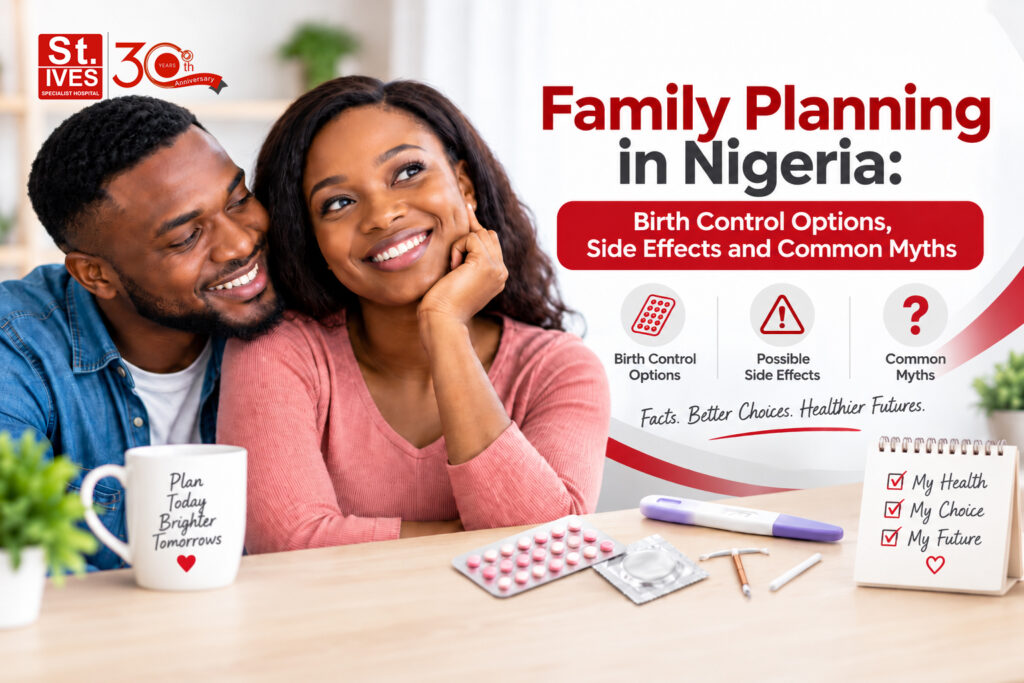
This article explains the major family planning methods in Nigeria, their possible side effects and some of the most common myths surrounding birth control.
Most importantly, it will help you understand how to make an informed choice with your doctor.
Why Family Planning in Nigeria Matters
Family planning helps individuals and couples decide whether they want children, when they want them and how much time they want between pregnancies.
It also allows women to recover properly between pregnancies and plan around their health, family and personal goals.
Yet many Nigerians still have questions or concerns about contraception.
The 2024 Nigeria Demographic and Health Survey reported that 15% of currently married women aged 15–49 use a modern contraceptive method. The figure increased from 12% in 2018.
However, many women who want to avoid or delay pregnancy still lack access to suitable family planning services.
Fear of side effects, misinformation, limited access and concerns about future fertility continue to influence contraceptive decisions.
That makes accurate information especially important.
What Does Family Planning Mean?
Family planning goes beyond taking pills or using an implant.
It involves making informed choices about pregnancy, birth spacing and reproductive health.
Contraception forms an important part of family planning.
However, no single birth control method suits everyone.
Your doctor may consider your:
- Age
- General health
- Blood pressure
- Menstrual pattern
- Breastfeeding status
- Medical history
- Current medications
- Future pregnancy plans
- Need for protection against sexually transmitted infections
Because these factors differ from person to person, the question should not simply be:
“What is the best family planning method?”
A better question is:
“Which family planning method is best for me?”
Family Planning Methods Available in Nigeria
Several birth control methods are available in Nigeria.
Some work for a short time. Others can prevent pregnancy for several years.
There are also hormonal, non-hormonal, barrier, emergency and permanent methods.
1. Contraceptive Implant
A contraceptive implant is a small, flexible rod that a trained healthcare professional places under the skin of the upper arm.
The implant slowly releases a hormone called progestin.
Depending on the product, it can prevent pregnancy for several years.
It is also one of the most effective reversible birth control methods.
Possible Implant Side Effects
Some women may experience:
- Irregular bleeding
- Spotting
- Lighter periods
- No periods
- Headaches
- Breast tenderness
- Acne
- Changes in weight
Bleeding changes are among the most common reasons women become concerned after getting an implant.
However, these changes do not usually mean something is wrong.
Can You Get Pregnant After Removing an Implant?
Yes.
The implant does not cause permanent infertility.
Fertility can return quickly after removal. Therefore, a woman who does not want to become pregnant should consider another method immediately after removing the implant.
2. Contraceptive Injection
Contraceptive injections are another common family planning option.
Depending on the type, a woman may receive the injection every two or three months.
This option may suit women who prefer not to take a pill every day.
However, you must return for each injection at the recommended time.
Possible Side Effects of the Family Planning Injection
Some women may notice:
- Irregular periods
- Spotting
- No periods
- Headaches
- Changes in appetite
- Weight changes
Some injectable contraceptives, especially DMPA, may contribute to weight gain in certain women.
Still, not every woman will gain weight.
Does the Injection Cause Infertility?
No.
However, some injections may delay the return of fertility after the last dose.
For example, ovulation may take several months to return after stopping DMPA.
This delay often causes confusion.
A woman may stop the injection, expect pregnancy immediately and become worried when conception does not happen within the first few months.
That does not mean the injection caused permanent infertility.
3. Birth Control Pills
Birth control pills are another widely known form of contraception.
Women take them regularly to prevent pregnancy.
There are two main types:
Combined pills contain estrogen and progestin.
Progestin-only pills contain only progestin.
Your doctor can help determine which type suits you.
Possible Side Effects of Birth Control Pills
Some women may experience:
- Nausea
- Headaches
- Breast tenderness
- Spotting
- Changes in menstrual bleeding
- Mood changes
These effects may improve as the body adjusts.
However, combined pills do not suit everyone.
Women with certain health conditions, including some blood-clotting problems or uncontrolled high blood pressure, may need another method.
Therefore, avoid choosing a contraceptive simply because it worked for a friend.
Do Birth Control Pills Cause Infertility?
No.
Fertility usually returns quickly after you stop taking birth control pills.
A woman may even ovulate before her first natural period after stopping the pill.
4. Intrauterine Devices or IUDs
An IUD is a small device that a trained healthcare professional places inside the uterus.
There are two main types.
The copper IUD does not contain hormones.
The hormonal IUD releases a small amount of hormone.
Both provide highly effective, long-term pregnancy prevention.
How Long Does an IUD Last?
The exact length depends on the product.
Some copper IUDs may work for 10 years or longer. Hormonal IUDs can also provide protection for several years.
However, a healthcare professional can remove the IUD earlier if you want to become pregnant or switch methods.
Possible IUD Side Effects
A copper IUD may cause:
- Heavier periods
- Stronger menstrual cramps
- More bleeding during the first few months
A hormonal IUD may cause:
- Irregular bleeding at first
- Lighter periods
- No periods in some women
Can an IUD Cause Infertility?
Modern IUDs do not cause infertility when healthcare professionals use them correctly in suitable patients.
Fertility usually returns quickly after removal.
5. Condoms
Condoms provide a non-hormonal birth control option.
They also offer something most other contraceptive methods cannot provide.
Condoms help reduce the risk of HIV and other sexually transmitted infections when people use them correctly and consistently.
External condoms, often called male condoms, remain the most common type.
Internal or female condoms also provide another option.
Can You Use Condoms With Another Family Planning Method?
Yes.
Some couples use condoms together with another contraceptive method.
For example, a woman may use an implant to prevent pregnancy while the couple also uses condoms to reduce the risk of sexually transmitted infections.
This approach provides dual protection.
6. Fertility Awareness Methods
Some couples prefer methods that do not involve hormones or medical devices.
Fertility awareness involves monitoring a woman’s menstrual cycle and identifying the days when pregnancy is more likely.
The couple then avoids unprotected sex during fertile days.
However, these methods require careful tracking.
Women with irregular menstrual cycles may also find them more difficult to use.
Anyone who strongly wants to avoid pregnancy should understand the limits of fertility awareness before relying on it alone.
7. Breastfeeding as Family Planning
Breastfeeding can temporarily reduce the chance of pregnancy after childbirth.
Doctors call this the Lactational Amenorrhoea Method, or LAM.
However, it only works reliably when three conditions apply:
- The baby is less than six months old.
- The mother’s period has not returned.
- The baby receives full or almost full breastfeeding.
Once any of these conditions changes, pregnancy can occur.
Therefore, mothers should discuss another contraceptive method with their healthcare provider if they want to avoid another pregnancy.
8. Emergency Contraception
Emergency contraception can help prevent pregnancy after unprotected sex.
A woman may also need it if:
- A condom breaks.
- She misses several birth control pills.
- She has sex without contraception.
- Another birth control method fails.
Emergency contraceptive pills mainly work by delaying or preventing ovulation.
They do not end an established pregnancy.
Does Emergency Contraception Affect Future Fertility?
No.
Emergency contraceptive pills do not cause permanent infertility.
However, emergency contraception should not replace a suitable regular family planning method.
If you find yourself needing emergency contraception often, speak with a healthcare professional about a more reliable long-term option.
9. Permanent Family Planning Methods
Some people know that they do not want any future pregnancies.
Permanent options include:
- Female sterilisation
- Vasectomy for men
These methods require careful thought because people should consider them permanent.
Doctors should provide proper counselling before anyone makes this decision.
Family Planning Side Effects: What Should You Expect?
Every contraceptive method has benefits and possible side effects.
However, experiencing a side effect does not automatically mean that a birth control method is dangerous.
Different people respond differently.
For example, one woman may use an implant with very little change to her periods. Another woman may experience frequent spotting.
Similarly, one woman may notice weight changes while using an injection, while another may not.
Common Side Effects by Method
| Family Planning Method | Possible Side Effects or Changes |
|---|---|
| Implant | Irregular bleeding, spotting, lighter periods, headache or acne |
| Injection | Irregular bleeding, no periods, possible weight changes and delayed return to fertility |
| Combined pill | Nausea, headaches, breast tenderness, spotting or changes in bleeding |
| Progestin-only pill | Changes in menstrual bleeding |
| Copper IUD | Heavier periods and stronger cramps, especially at first |
| Hormonal IUD | Irregular bleeding at first, followed by lighter periods in some women |
| Condom | No hormonal side effects; some people may have latex sensitivity |
| Emergency pill | Temporary nausea, tiredness or changes in the next period |
Do not suffer in silence if a method causes uncomfortable symptoms.
Talk to your healthcare provider.
Sometimes your doctor can help you manage the side effects. In other situations, changing the contraceptive method may provide a better solution.
Can Family Planning Make You Infertile?
This question deserves a clear answer.
Reversible family planning methods do not normally cause permanent infertility.
Pills, implants and IUDs allow fertility to return after a woman stops using them.
The contraceptive injection may take longer, especially with DMPA.
However, a delay in fertility is not permanent infertility.
Why Do Some Women Struggle to Conceive After Stopping Birth Control?
Sometimes another fertility problem already exists.
For example, a woman may have:
- Polycystic ovary syndrome, or PCOS
- Endometriosis
- Blocked fallopian tubes
- Fibroids that affect the womb
- Low ovarian reserve
- Irregular ovulation
Male fertility problems may also affect the couple.
Age matters too.
A woman may start contraception in her 20s and stop several years later. Fertility naturally changes with age, especially after 35.
In that situation, people may blame the contraceptive even though age or another medical condition contributes to the difficulty.
When Should You Seek Fertility Help?
Couples under 35 should usually speak with a fertility specialist if pregnancy has not occurred after 12 months of regular unprotected sex.
Women aged 35 or older should consider getting help after six months.
You may need an earlier assessment if you have irregular periods, known reproductive health problems or other fertility concerns.
Does Family Planning Cause Weight Gain?
This is another common question about family planning in Nigeria.
The answer depends on the method and the person.
Not every contraceptive causes significant weight gain.
Your weight can change because of:
- Diet
- Physical activity
- Stress
- Sleep
- Age
- Pregnancy history
- Hormonal conditions
- Other health problems
Therefore, weight gain while using contraception does not always mean the contraceptive caused it.
Which Family Planning Method Is Linked to Weight Gain?
Research shows a stronger link between weight gain and the DMPA contraceptive injection than many other methods.
Still, individual experiences differ.
If weight change concerns you, mention it during your family planning consultation.
Your doctor can discuss hormonal and non-hormonal options with you.
Which Family Planning Method Is Best?
There is no single best family planning method for everyone.
The right option depends on your health and plans.
For example, a woman hoping to have another baby next year may choose differently from someone who does not want another pregnancy for five years.
A breastfeeding mother may also need different advice from a woman who has never had a baby.
Likewise, someone who needs protection against sexually transmitted infections should consider condoms.
Questions to Consider Before Choosing a Method
Ask yourself:
- How soon might I want a pregnancy?
- Do I want a daily method or something long-term?
- Am I breastfeeding?
- Do I have heavy or painful periods?
- Do I have high blood pressure or another medical condition?
- Do I need protection from sexually transmitted infections?
- How do I feel about possible changes to my periods?
- Have I had side effects from birth control before?
Discuss your answers with a qualified healthcare professional.
The best method is not necessarily the one your friend uses.
It should match your health, lifestyle and future plans.
Which Family Planning Method Does Not Cause Weight Gain?
Many women search for the best family planning method without weight gain.
No doctor can promise that your body weight will remain exactly the same while using any method.
However, non-hormonal options such as condoms and the copper IUD do not contain contraceptive hormones.
Hormonal methods affect people differently.
If you experienced significant weight changes while using contraception before, tell your doctor which method you used.
That information can help guide the next choice.
Can I Get Pregnant After Stopping Contraception?
Yes.
Pregnancy can occur after stopping most reversible contraceptive methods.
Fertility may return quickly after:
- Stopping birth control pills
- Removing an implant
- Removing an IUD
Therefore, do not assume you have several months of protection after stopping these methods.
The contraceptive injection may work differently.
Some women need several months before regular ovulation returns after their last DMPA injection.
If you plan to start trying for a baby soon, discuss that timeline with your doctor before choosing a contraceptive.
Which Contraceptive Is Suitable After Childbirth?
Women often ask about the best family planning method after childbirth.
There is no single answer for every new mother.
Your doctor will consider:
- How recently you delivered
- Whether you are breastfeeding
- Your general health
- Any pregnancy or delivery complications
- Your preferred birth spacing
- When you may want another pregnancy
Options may include implants, IUDs, progestin-only pills, injections or condoms.
The timing of each method also matters.
For this reason, pregnancy and postnatal appointments provide a good opportunity to discuss family planning with your obstetrician or gynaecologist.
Can You Get Pregnant Before Your First Period After Delivery?
Yes.
Ovulation can happen before your first menstrual period after childbirth.
That means a woman can become pregnant even though her periods have not returned.
Breastfeeding may reduce the chance of pregnancy, but it only works as contraception under the specific LAM conditions described earlier.
Common Family Planning Myths in Nigeria
Misinformation can stop people from making informed health choices.
Here are some common myths and the facts behind them.
Myth 1: “You Must Have Children Before Using an IUD or Implant”
Not necessarily.
Doctors do not choose contraceptive methods only according to whether a woman has previously given birth.
They consider her health, reproductive plans and other medical factors.
Women who have not had children may still qualify for an implant or IUD.
Myth 2: “Family Planning Causes Fibroids”
There is no good evidence that modern contraception simply causes uterine fibroids.
In fact, doctors sometimes use certain hormonal methods to help control heavy menstrual bleeding.
However, symptoms such as very heavy periods, pelvic pain or abdominal swelling still need proper medical assessment.
Fibroids, endometriosis, adenomyosis and other conditions can cause similar symptoms.
Myth 3: “If My Period Stops, Blood Is Storing Inside My Body”
This is false.
Some hormonal contraceptives make periods much lighter.
Others may stop menstrual bleeding completely.
The blood does not collect inside your body.
Hormonal contraception can keep the lining of the uterus thin. As a result, there may be little or nothing to shed during a period.
However, take a pregnancy test or contact your healthcare provider if pregnancy is possible and your period stops unexpectedly.
Myth 4: “Emergency Contraception Is the Same as Abortion”
It is not.
Emergency contraceptive pills mainly prevent or delay ovulation.
They do not end an established pregnancy.
This difference is important when discussing reproductive health.
Myth 5: “Family Planning Is Only a Woman’s Responsibility”
Family planning should involve open and respectful conversations between partners.
Men can participate through:
- Condom use
- Vasectomy when permanent contraception is desired
- Supporting clinic visits
- Discussing pregnancy spacing
- Learning about contraception
- Respecting their partner’s healthcare decisions
Shared understanding can reduce pressure and misinformation.
When Should You See a Doctor About Family Planning?
You do not need to wait until something goes wrong before seeing a doctor.
Consider a consultation if you:
- Want to start contraception for the first time
- Want to change your current method
- Experience troubling side effects
- Recently had a baby
- Are breastfeeding
- Plan to become pregnant soon
- Have high blood pressure or another medical condition
- Take regular medication
- Have irregular or unusually heavy periods
Your healthcare provider can review your medical history and explain which methods may suit you.
Warning Signs You Should Not Ignore
Serious problems with modern contraception are uncommon.
However, seek medical care if you develop severe or unusual symptoms.
These may include:
- Severe chest pain
- Difficulty breathing
- Sudden severe headaches
- Fainting
- Very heavy bleeding
- Severe abdominal or pelvic pain
- Sudden weakness or unusual neurological symptoms
Do not assume every symptom comes from contraception.
A doctor can find the actual cause.
Family Planning Should Be Based on Facts, Not Fear
Family planning should help people make informed decisions about their reproductive health.
It should not create fear.
Unfortunately, myths about infertility, weight gain, damaged wombs and menstrual blood still influence decisions about family planning in Nigeria.
Accurate medical information can help change that.
Before accepting advice from social media, WhatsApp groups, friends or relatives, speak with a trained healthcare professional.
Your sister’s experience may not be your experience.
Your friend’s contraceptive may not be the right contraceptive for you.
Most importantly, your family planning decision should reflect your own health and future plans.
Frequently Asked Questions About Family Planning in Nigeria
Reversible contraceptive methods such as pills, implants and IUDs do not normally cause permanent infertility.
Fertility usually returns after stopping them.
Some contraceptive injections may delay fertility for several months after the last dose.
There is no single method that works best for everyone.
Your doctor should consider your medical history, future pregnancy plans, breastfeeding status, lifestyle and personal preferences.
Yes.
Fertility can return quickly after stopping pills or removing an implant or IUD.
The DMPA contraceptive injection may take longer.
Not every contraceptive causes weight gain.
The DMPA injection has a stronger link with weight gain than many other methods, but individual experiences differ.
Non-hormonal methods such as condoms and the copper IUD do not contain contraceptive hormones.
However, many factors can affect body weight.
Discuss your concerns with a doctor before choosing a method.
Suitable options may include implants, IUDs, condoms, progestin-only pills or injections.
The best option depends on how recently you delivered, whether you are breastfeeding and your medical history.
Talk to a Women’s Health Specialist at St. Ives Specialist Hospital
Choosing a family planning method should not feel like guesswork.
At St. Ives Specialist Hospital, our women’s health, obstetrics and gynaecology teams help women and couples understand their contraceptive options.
Our doctors can consider your medical history, lifestyle, breastfeeding status and future pregnancy plans before recommending suitable options.
St. Ives Specialist Hospital also provides specialist services in fertility and IVF, women’s health, men’s health, pregnancy and maternity care, children’s health, family medicine and general wellbeing.
For couples who are ready to start or grow their families, our fertility specialists can also assess challenges that may make conception difficult.
With specialist care available across our locations in Lagos and Abeokuta, patients can receive support at different stages of their family and reproductive health journey.
Thinking about starting, changing or stopping a family planning method?
Speak with a qualified St. Ives healthcare professional for personalised advice via WhatsApp with the link: https://wa.me/2347034246413
When it comes to family planning, the right decision starts with the right information.
